
Everyone expects the dog to be the troublemaker. In our house, it’s the cat.
We share our home with four rescues: two dogs, Gracie (a nearly 15-year-old Yorkie) and Sabrina (a Poodle/Bichon mix, about 8), and two cats, Max and Molly, a brother-and-sister pair of 12-year-old tabbies. Molly mostly minds her own business. Max, on the other hand, has made it his life’s work to pester the dogs.
Meet Max, the Household Pest
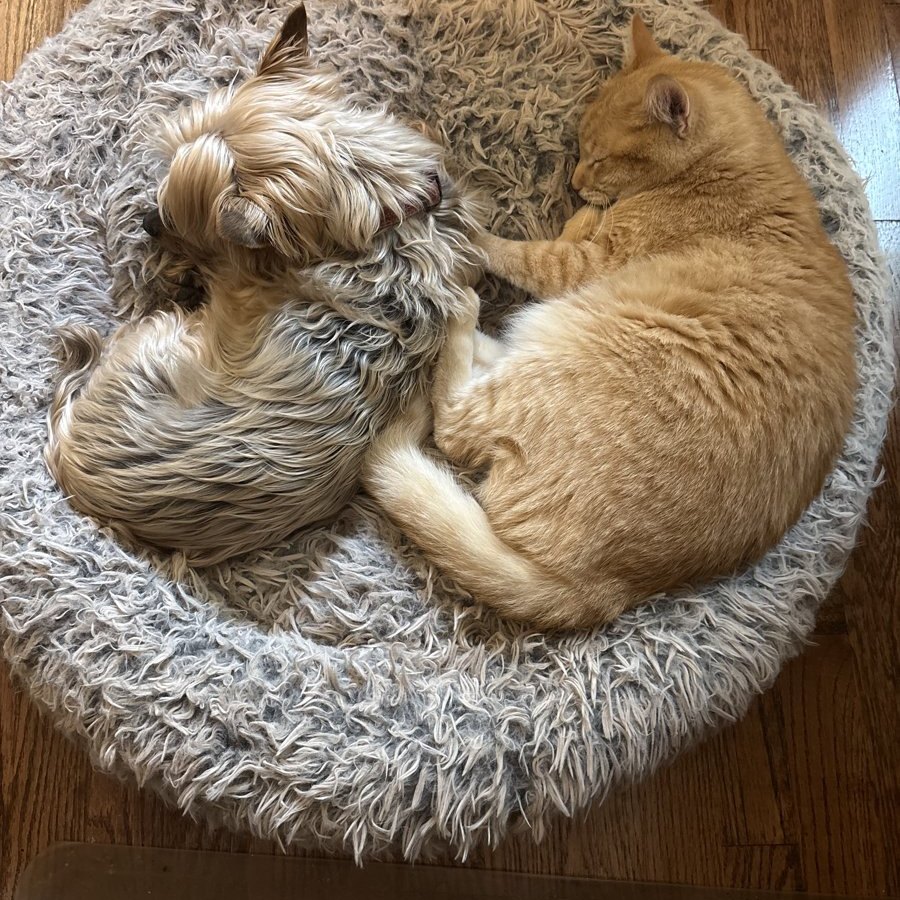
If a dog is lying in a bed, Max will climb in with them. Then he starts pushing on their back or rubbing up against them until they give up and get out. Bed acquired.
If the dogs are standing, he’ll walk right past their faces, rubbing his back or side across their noses and parking his tail directly in their faces. Basically, anything to get close to them and annoy them.
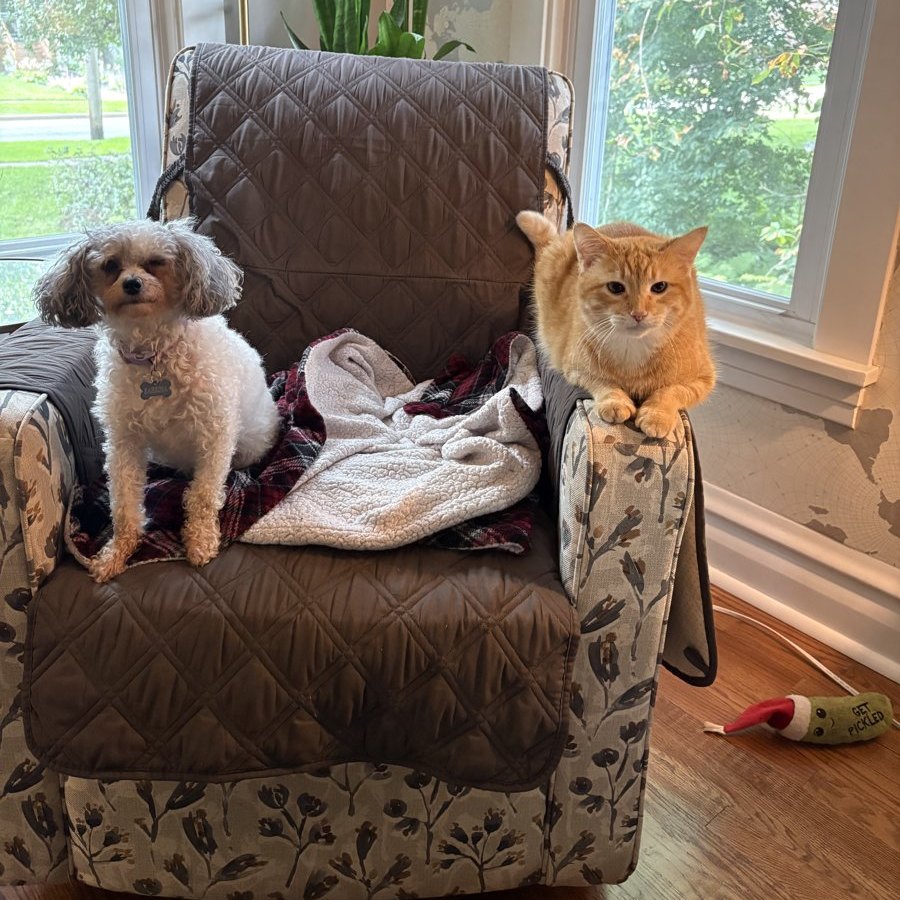
The funny part? Max can dish it out, but he can’t take it. If one of the dogs tries to do anything to him, he immediately lets them know he does not approve, usually with a quick swipe of his paw. He is not a fan of the dogs doing anything to him.
The Dogs Couldn’t Care Less About Cats
When we first brought Gracie home, we had three cats. They didn’t really care about her, and she didn’t care about them. That has stayed true her whole life: through every cat we’ve had, Gracie has simply ignored them.
Sabrina is the same. Most of the time the dogs and cats just ignore each other, unless something’s going on, and then everybody likes to annoy everybody. Having calm, cat-indifferent dogs has made living with both a lot easier than people might expect.
After years of living with both cats and dogs, here’s what helps keep the peace in our house, whichever animal is causing the trouble.
1. Give Everyone Their Own Spot
Cats feel safest up high, so cat trees, shelves and window perches let them watch the action without being in the middle of it. Max and Molly have a cat tree, though it’s mostly Max who uses it. The dogs have their own “levels” too, perches by the window where they sit and watch the neighborhood.
Molly has claimed the space under a chair in our dining room. We put a bed with a heating pad under there, and she sleeps in it all the time. Max is the opposite: he sleeps anywhere and everywhere he can find a spot. He’s an equal-opportunity sleeper, which is part of why the dogs’ beds are never safe.
Older pets especially appreciate a warm, quiet place of their own. If you use a heating pad, pick one made for pets and make sure they can move off it easily.
2. Feed Them Separately
Cat food is richer in protein and fat than most dog food, and dogs will happily raid the cat bowl. An occasional nibble usually isn’t a crisis, but a regular habit can upset a dog’s stomach and add weight (more on that in our post on why dogs eat cat food).
Here’s how we handle mealtimes with four pets:
- Dry cat food lives up on a table, where the dogs can’t get to it.
- Wet food for the cats happens in the morning and evening, and we physically hold the dogs back while the cats eat. If we don’t pay attention, the dogs will push their way in and eat all of it. The cats don’t fight back; they just look at them.
- The dogs eat at different times, getting raw food twice a day. The cats don’t show any interest in it.
3. Keep the Litter Box Dog-Free
Many dogs are drawn to the litter box, which is unpleasant for everyone and stressful for the cat. Ours are in the basement, and the dogs don’t go down there, so it’s never been an issue for us. If you don’t have that option, a covered box with a top entry, or a baby gate the cats can hop over and the dogs can’t, gives the cats privacy.
4. Learn to Read the Room
Not all pestering is a problem. Max’s antics are annoying to the dogs, but nobody gets hurt. They just get up and move. Watch for signs that one animal has really had enough:
- Cat: flattened ears, a puffed or lashing tail, hissing or growling
- Dog: turning away, lip licking, freezing, a stiff body or a growl
When one animal is clearly trying to leave and the other keeps following, it’s time to step in and redirect, usually with a toy for the cat.
5. Give the Pest Something Better to Do
A lot of “pest” behavior is boredom or attention-seeking. Interactive play sessions with a wand toy, puzzle feeders and a good window perch can burn off some of the energy a cat might otherwise spend harassing the dogs. See our guide to interactive cat toys for ideas.
What Living With Both Has Taught Us
Cats and dogs don’t have to be best friends to share a home. Ours mostly ignore each other, and that’s a win. The things that matter most are simple: everyone gets their own space, the food stays out of reach of whoever shouldn’t have it, and the litter boxes stay off-limits. And if you end up with a Max, just accept that the dog beds now belong to the cat.
Helpful Products
- Cat trees: Gives cats a high spot of their own, away from the dogs.
- Pet heating pads: What we use under Molly’s dining room bed.
- Pet window perches and seats: A lookout spot so the dogs have their own “level” too.
- Top-entry litter boxes: Helps keep curious dogs out if the litter box can’t go somewhere off-limits.
Cats and Dogs Living Together FAQ
Can cats and dogs really live together peacefully?
Yes. Many cats and dogs share homes happily, especially when each has its own space, separate feeding areas and a safe place to retreat.
Why does my cat bother my dog?
Often it’s play, curiosity, attention-seeking or boredom. Some cats simply enjoy the reaction, or want the dog’s warm spot. More playtime and enrichment for the cat usually helps.
Why does my cat rub against my dog?
Cats rub against people and animals to leave their scent, which is a sign of familiarity. With a cat like Max, it can also just be a way to get the dog to move.
How do I stop my dog from eating cat food?
Feed cats up high or behind a gate or door the dog can’t get through, supervise wet-food meals, and pick up leftover food afterward.
When should I separate a cat and dog?
If either animal is showing clear signs of fear or aggression, or one can’t get away from the other, separate them and give them time apart. Talk to your vet or a qualified trainer if tension continues.
As an Amazon Associate, we earn from qualifying purchases. This post contains affiliate links.